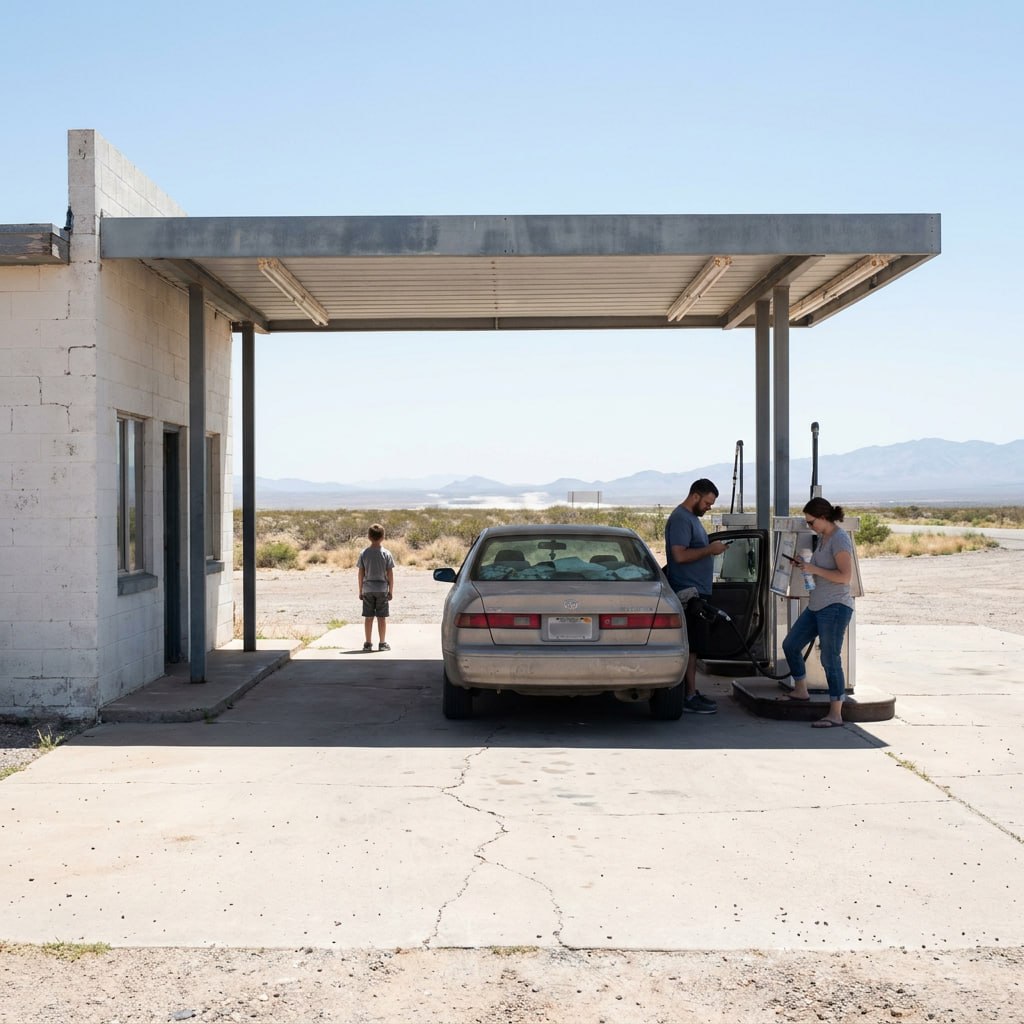
A family stopped at a remote desert gas station under the midday sun
photographytravel_photographystreet_scene
Förstora
A photorealistic candid documentary photograph shot from about ten meters behind a family at a lone two-pump gas station on a straight highway in the high desert outside Marfa, Texas, at solar noon in July.

A boy of about seven stands at the very edge of the concrete apron where it meets the dirt, seen from behind, arms hanging loose, feet together, completely motionless. He wears a t-shirt, shorts and sneakers with one sock slipped down. His head is tilted very slightly. He is staring straight into the shimmering mirage on the horizon and he has not moved in two minutes.

The horizon dissolves into a genuine inferior mirage: a false silver-blue waterline where the superheated ground meets the air, distant scrub and a low mountain range wavering and detaching from the earth, the bottoms of distant objects smeared and inverted. The distortion is atmospheric, not optical, strongest near the ground and fading with height. It is the only thing moving in the entire frame and it is worth looking at.

Twenty feet behind him under the station canopy, his father stands at the pump with the nozzle in the car's tank and a phone held at chest height in his other hand, head down, thumb moving. His mother is half out of the passenger door with one foot on the ground, a water bottle in one hand and a phone in the other, also looking down. Their two heads are tilted at exactly the same angle. Neither is looking at the boy. Neither is looking at the desert.

The car is a dusty crossover with a rooftop box and the debris of a long drive visible through the rear window, a matte film of pale caliche dust across its lower panels. The station is two pumps, a low steel canopy with a dent at one corner and a swallow's nest in a beam, and a sun-faded white cinderblock building with a screen door and an ice chest outside. Behind and around it, nothing: pale gravel, creosote and yucca, a barbed-wire fence and a line of telephone poles marching to a vanishing point and dissolving into the shimmer. A hundred kilometers of emptiness.

Vertical midday sun bleaches everything. Shadows are short and hard, puddled directly beneath the pumps and beneath the boy's own feet. The canopy casts a single sharp black rectangle on the oil-stained concrete. The sky whitens toward the horizon until it blows out where the mirage begins. Heat shimmer rises visibly from the concrete and the car hood. The air is dead still.

Shot at 50mm f/8, ISO 100, 1/500s on a mirrorless camera. Deep depth of field keeps the boy, the parents, the car and the station all sharp, with the horizon soft from heat distortion rather than focus, and that distinction must be visible. The palette is drained and bleached, with the boy's t-shirt as the only real color note.

The composition places the boy small at the left third against the mirage band, the parents and the car at the right third with their two downturned heads echoing each other, and the empty desert filling everything in between. The eye goes to the boy first because he is the only one facing outward, follows his gaze into the shimmer, then comes back and notices the two people who are missing it. The mood channels Stephen Shore's deadpan American roadside: nothing happens, and a child encounters infinity while two adults watch a fuel counter climb.