Polar Bear Club New Year's Day Plunge at Coney Island
action_shotcelebrationphotographystreet_scene
Förstora
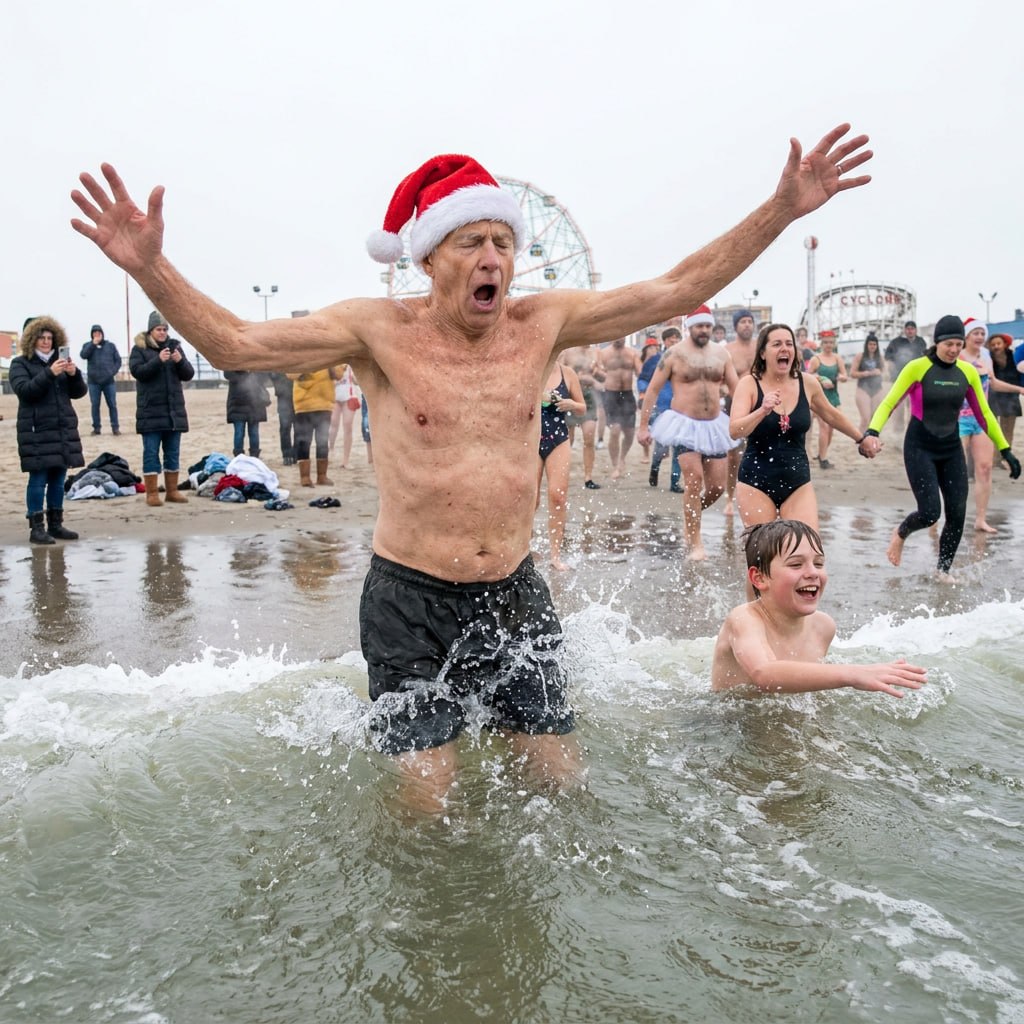
A photorealistic candid action photograph shot from in the water about four meters out at chest height, facing back toward the beach, during the Coney Island Polar Bear Club New Year's Day plunge in Brooklyn.

A man of about seventy-five stands chest-deep at the instant the first wave passes over him. Lean and wiry with the loose sun-spotted skin of a lifelong swimmer, he is caught in pure cold-shock reflex: mouth fully open in a gasp, head tilted back, both arms flung out and up, fingers splayed. He wears baggy old swim trunks and a soaked red felt santa hat now flopping sideways with the white trim matted flat against his forehead. Nothing about the posture is chosen. His body registered 4°C water before his brain did.

Two meters beside him a ten-year-old is already submerged to the shoulders, face turned up, mouth open in a genuine laugh, hair slicked flat and dripping, one hand slapping the surface. Completely unbothered. Same water, same second, opposite reaction, and that contrast is the whole picture.

The low winter shore break explodes around them, grey-green and churned sandy near the wave face, white aerated foam on top, spray flung outward and upward and frozen as thousands of individual droplets across the frame. Behind them twenty or thirty other bathers are at every possible stage at once: two women holding hands and screaming as they run in, a heavy man in a tutu wading with his arms overhead, someone in a neon full-body suit, an older woman calmly breaststroking past everyone, several people already sprinting back to the sand. Antlers, tinsel, a cape. Nobody coordinated with anybody.

Further back the wet dark sand is churned with hundreds of overlapping footprints and littered with careless heaps of abandoned sweatshirts, sneakers, towels and plastic bags. Spectators stand bundled in heavy parkas holding phones up, one man wrapped in a foil blanket, and their winter clothing makes the swimmers look even more insane. On the skyline the Wonder Wheel and the Cyclone are recognizable but clearly soft, closed and motionless for the season, with no readable lettering anywhere.

Faint steam rises off wet shoulders and backs where warm skin meets freezing air. Exposed skin is goosebumped and blotching pink and red. The light is flat hard white January overcast, cold and directionless, merciless and entirely without warmth.

Shot at 50mm f/4, ISO 400, 1/2000s on a mirrorless camera. The fast shutter freezes every droplet of spray and the old man's flung arms with no blur. The old man and the child are tack-sharp, the crowd softens with distance, the boardwalk and rides go clearly soft. The palette is cold and desaturated — grey-green ocean, white foam, white sky, dark wet sand, pale blotched winter skin — with the red santa hat and a few costume accents as the only warm color in the frame.

The composition puts the man's open mouth at the left third and the child's laughing face at the right third with the wave's white water running between them. The eye hits the shock first, then finds the kid, and the picture completes itself. The mood sits between Garry Winogrand's crowd energy and Martin Parr's deadpan absurdity: a few hundred ordinary New Yorkers running into a freezing ocean for no reason except that they always have.