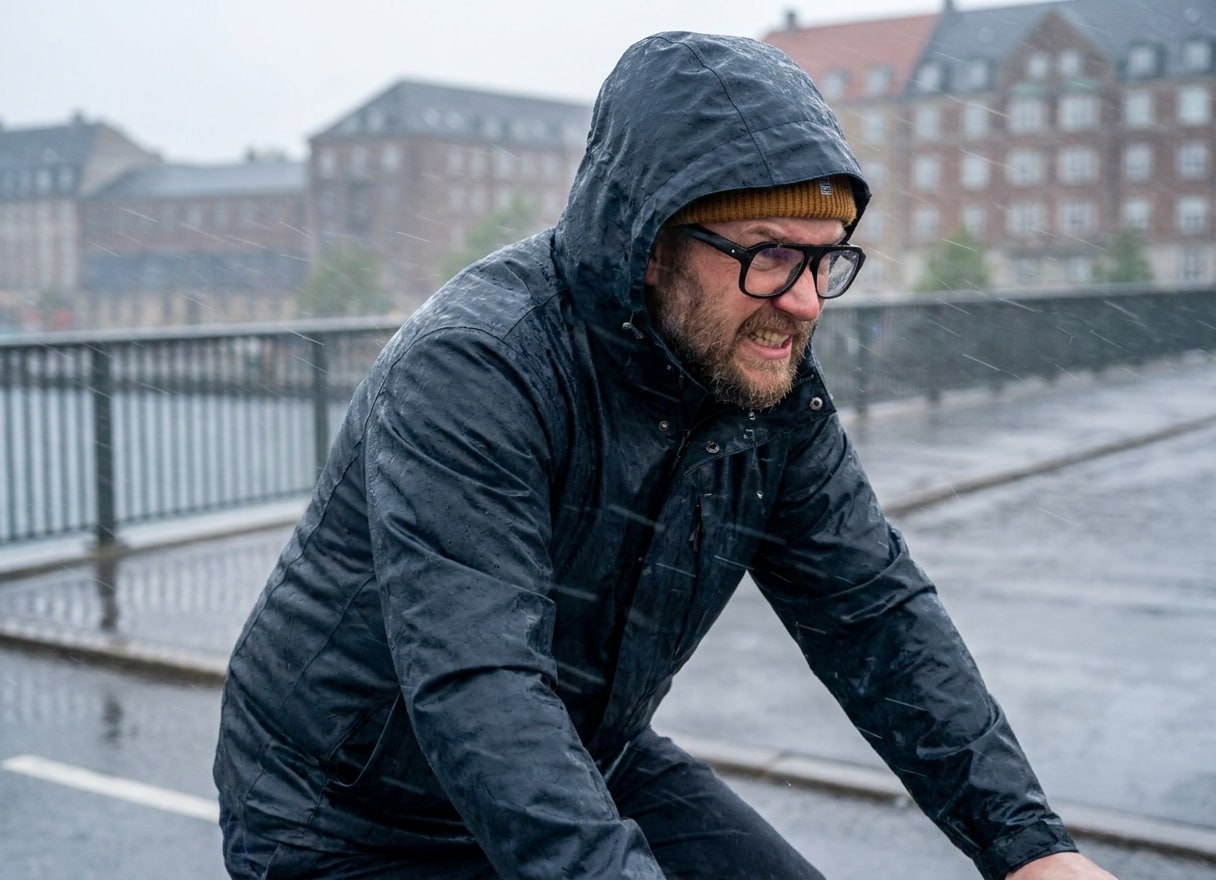
Lone Cyclist Battling Storm on Copenhagen Bridge
photographystreet_scenetravel_photographycinematicfine_art
Förstora
{
  "core": {
    "subject": "a lone cyclist crossing Dronning Louises Bro in Copenhagen during a fierce sideways rainstorm, body and bicycle leaning at an extreme angle into the wind — the rain frozen as horizontal streaks across the frame, the empty bridge stretching out behind into grey mist",
    "scene": "Dronning Louises Bro, the wide flat bridge connecting Nørrebro and the city center, in the middle of a sudden autumn squall. The bridge is completely deserted except for the single cyclist. The lakes on both sides are invisible in the driving rain and mist",
    "objects": [
      "one cyclist on a classic black Danish city bike — upright frame, chain guard, rear rack, the everyday Copenhagen commuter bicycle. The cyclist leans approximately 20-25 degrees into the wind to stay upright, body hunched forward over the handlebars, head down against the rain",
      "the rain — falling nearly HORIZONTALLY from left to right across the frame, driven by the strong wind. Individual rain streaks visible as sharp bright diagonal lines against the dark grey sky and darker bridge surface. The rain is dense enough to partially obscure the far end of the bridge",
      "the bridge surface — wide, flat, wet asphalt with painted cycle lane markings barely visible under the water. A thin film of running water on the surface reflecting the grey sky and the cyclist's dark silhouette as a blurred elongated mirror image",
      "the bridge railings — simple white-painted iron railings running along both sides, receding into the mist in parallel perspective lines. The railings provide the only strong geometric structure in an otherwise dissolved landscape",
      "the far end of the bridge — dissolving into grey rain mist, the buildings on the opposite side reduced to vague dark shapes. The vanishing point is swallowed by weather",
      "a single abandoned bicycle locked to the railing in the middle ground — nobody else brave or foolish enough to be out",
      "the cyclist's clothing — a dark rain jacket with hood pulled tight, dark trousers soaked through and clinging to the legs, one trouser leg tucked into a sock. No umbrella — this is a Dane who chose to ride through it"
    ],
    "actions": [
      "the cyclist pedaling steadily into the headwind — not sprinting, not stopping, just the determined forward push of someone committed to getting to the other side. The body lean is dramatic but controlled — practiced, habitual, the specific angle a Copenhagen cyclist learns through years of bridge crossings in bad weather",
      "rain hitting the cyclist's jacket and running off in streaks — water spraying from the rear wheel in a low arc behind the bike"
    ],
    "constraints": [
      "CRITICAL LEAN ANGLE — the cyclist must be leaning INTO the wind at a dramatic but physically plausible angle of approximately 20-25 degrees from vertical. The lean is what makes the image — it shows the invisible force of the wind by its effect on the body. Without the lean, it is just a person cycling in rain. With the lean, it is a person battling an elemental force",
      "CRITICAL RAIN DIRECTION — the rain must fall nearly HORIZONTALLY from left to right, driven by the wind. The rain streaks must be consistent in angle throughout the frame — all parallel, all from the same direction. This consistency is what sells the wind. Any vertical rain contradicts the horizontal streaks and breaks the illusion",
      "CRITICAL EMPTINESS — the bridge must be DESERTED except for the single cyclist. The emptiness of a normally busy bridge is what communicates the severity of the storm. The lone figure against the vast empty wet bridge is the compositional core — human smallness against weather and urban geometry",
"CRITICAL MINIMALISM — the image must feel GRAPHICALLY REDUCED. Grey sky, grey wet bridge, dark cyclist, white railings, horizontal rain streaks. Almost monochrome. Almost abstract. The palette is limited to greys, blacks, and white with perhaps the faintest cold blue undertone. This is Scandinavian minimalism imposed by weather rather than design",
      "CRITICAL — the far end of the bridge must DISSOLVE into rain mist. The bridge does not end at a visible point — it fades into grey obscurity. This atmospheric dissolution gives the image depth and loneliness and the sense of an infinite wet journey ahead",
      "no visible faces — the cyclist's head is down, hood pulled tight, face hidden from the rain and from the camera",
      "the rain streaks must look like real rain frozen by a fast shutter — sharp, bright, parallel lines of consistent thickness. Not soft, not blurred, not varying in angle"
    ]
  },
  "style": {
    "primary_style": "photorealistic minimalist street photography — graphic, reduced, almost abstract in its simplicity. The weather is the composition tool",
    "render_quality": "high-resolution",
    "lighting": "flat overcast storm light — no directional sun, no shadows, no warmth. A uniform grey illumination from the dense cloud cover that eliminates contrast and reduces everything to tonal values. The only brightness is the wet bridge surface reflecting the grey sky and the white bridge railings. The rain streaks appear bright because they catch this flat ambient light against the darker background",
    "color_profile": "near-monochrome — dark greys, mid greys, light greys, black cyclist, white railings. The only hint of color is a cold blue-grey undertone in the sky and water. No warm tones anywhere. The palette is deliberately Scandinavian: restrained, cool, severe, beautiful in its austerity"
  },
  "technical": {
    "camera": {
      "type": "Mirrorless",
      "lens": "50mm prime",
      "aperture": "f/4",
      "focal_length_mm": 50,
      "depth_of_field": "medium-deep — the cyclist sharp, the railings receding into the mist sharp enough to read their perspective convergence, the far end of the bridge softened by atmospheric haze rather than optical blur",
      "shutter_speed": "1/500s — fast enough to freeze individual rain streaks as sharp bright lines rather than soft blurs, and to freeze the cyclist's pedaling motion with no blur on the legs",
      "iso": 800
    },
    "resolution": {
      "target": "4k",
      "min_quality": "professional-quality"
    },
    "rendering": {
      "anti_aliasing": true,
      "noise_level": "low-medium — slight grain consistent with overcast storm conditions",
      "color_depth": "high"
    },
    "physics_accuracy": {
      "gravity_cues": true,
      "structural_believability": true
    }
  },
  "materials": {
    "surfaces": [
      "wet asphalt bridge surface — dark grey, covered in a film of running water that reflects the grey sky as a broad diffused mirror. Painted cycle lane markings barely visible under the water as faint white lines. The reflection of the cyclist visible as a dark elongated smear on the wet surface",
      "white-painted iron bridge railings — simple vertical bars between horizontal rails, the white paint chipped and slightly rusted at the base. Rain water running down each bar. The railings are the only crisp geometric element in the soft grey landscape",
      "the bicycle — a classic black Danish city bike, practical and unglamorous. Fenders, chain guard, rear rack, kickstand. Water dripping from every surface. The spokes blurred by wheel rotation. A thin spray of water arcing from the rear wheel",
      "the cyclist's rain jacket — dark navy or black, waterproof fabric with visible rain water streaming off the surface. The hood cinched tight around the face leaving only darkness inside. The fabric pressed against the body on the wind-facing side, ballooning slightly on the lee side",
"soaked trousers clinging to the legs — the fabric dark and heavy with water, showing the contour of the thighs and knees through the wet material"
    ],
    "fabric_details": "the clothing is pure function — a rain jacket chosen for waterproofing not style, dark trousers already ruined by the weather. One trouser leg tucked into a sock to keep it from the chain. This detail is the universal badge of the Copenhagen cyclist"
  },
  "environment": {
    "atmosphere": [
      "the particular Danish stubbornness of cycling through weather that would stop anyone else — not heroism, just pragmatism. The bus costs money and this is only water",
      "the graphic beauty of a city stripped to its bones by bad weather — all decoration removed, all color drained, all non-essential people gone, leaving only geometry, grey, and one determined human",
      "the sound of wind and rain implied by the visual evidence of horizontal rain and the extreme lean angle"
    ],
    "time_season": [
      "late autumn — October or November, the season of Atlantic storms crossing Denmark",
      "midday — but the storm has reduced the light to a dim grey twilight. Time of day barely matters under this cloud cover"
    ],
    "particles": [
      "rain streaks — the primary visual element after the cyclist. Dense, horizontal, sharp, parallel, bright against dark backgrounds and invisible against the bright sky. The rain IS the atmosphere, not just in it",
      "fine spray kicked up by the bicycle wheels — a low mist of water trailing the bike",
      "possibly the faintest mist or spray being whipped off the bridge railings by the wind"
    ]
  },
  "composition": {
    "perspective": "from the bridge itself, approximately 20 meters ahead of the cyclist, looking back along the bridge's length. The camera is positioned in the cycle lane so the cyclist is riding TOWARD the camera. The bridge stretches out BEHIND the cyclist into the dissolving mist. This puts the lone figure against the vast empty receding space",
    "framing": "the cyclist positioned in the center-right of the frame, leaning left into the wind. The bridge stretches from the cyclist backward into the mist toward the upper-left of the frame, the white railings converging toward a vanishing point that disappears into grey. The wet bridge surface fills the lower half as a dark reflective plane. The grey sky fills the upper half. The horizontal rain streaks cross the entire frame from left to right. The image is essentially divided into two horizontal halves — dark wet ground below, grey wet sky above — with the cyclist as the sole vertical element connecting them",
    "subject_placement": "the cyclist at the right-third vertical line, leaning leftward into the wind. The empty bridge receding behind them occupies the left two-thirds of the frame — this emptiness is not wasted space, it IS the subject alongside the cyclist. The vanishing point of the bridge railings at the upper-left third intersection, dissolving into rain mist"
  },
  "quality_keywords": {
    "include": [
      "photographic quality",
      "authentic textures",
      "Copenhagen cycling culture",
      "horizontal rain frozen as sharp streaks",
      "extreme wind lean angle",
      "graphic minimalist composition",
      "near-monochrome grey palette",
      "lone figure against vast empty geometry",
      "Scandinavian weather as aesthetic",
      "Harry Gruyaert graphic color reduction"
    ],
    "avoid": [
      "vertical or gentle rain — it must be driven nearly horizontal by strong wind",
      "inconsistent rain angles — all streaks must be parallel from the same direction",
      "other people or cyclists on the bridge — the solitude is essential",
      "warm tones or sunlight — cold grey throughout",
      "visible face — hidden in the hood, head down",
      "upright cycling posture — the dramatic lean angle is the image",
      "soft or blurred rain — frozen as sharp streaks by fast shutter",
      "visible far shore in detail — must dissolve into rain mist",
"colorful clothing or bicycle — dark and muted only",
      "digital artifacts"
    ]
  }
}